The host doctor
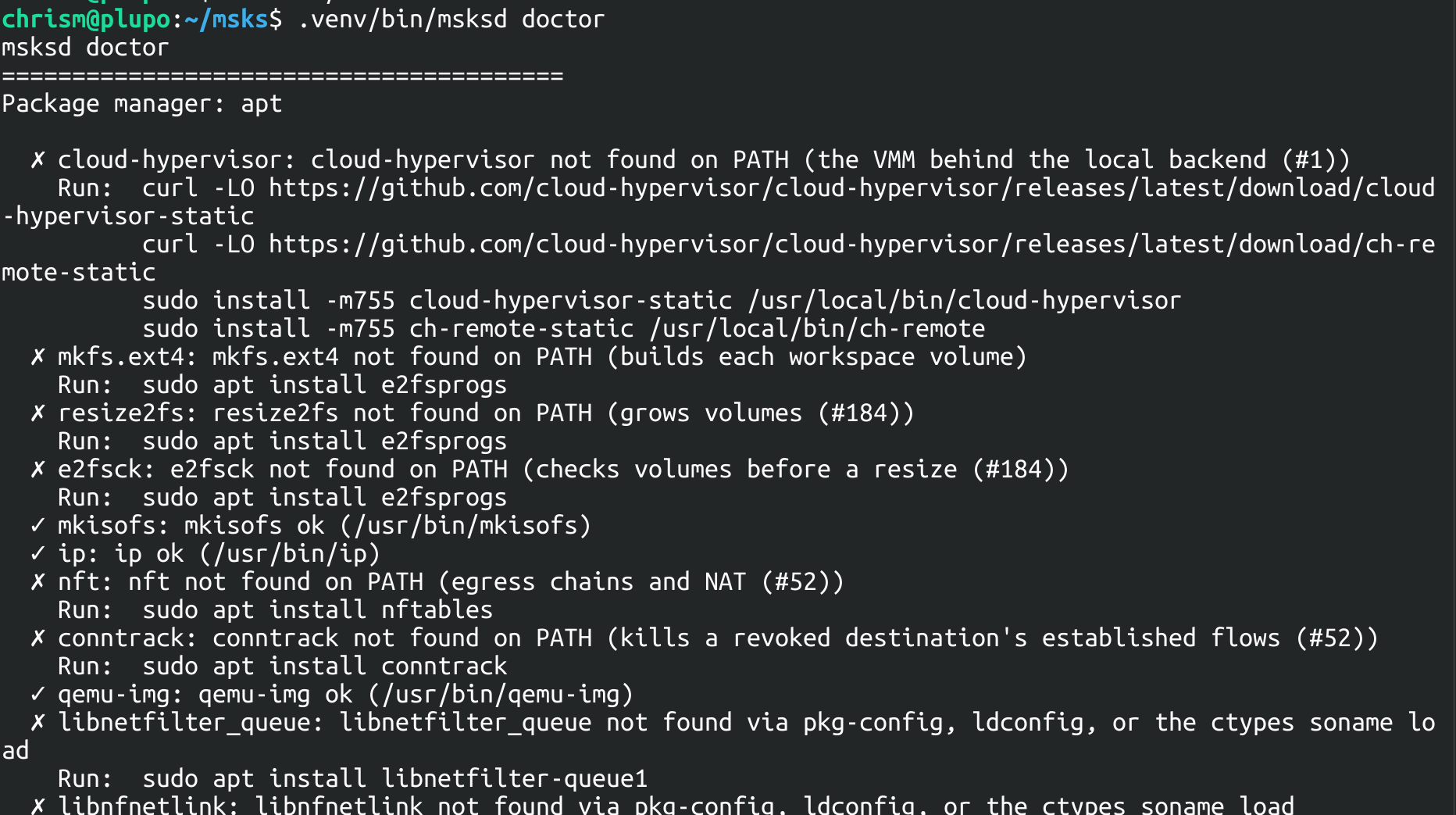
msksd doctor checks the host for the tools and libraries the
daemon and the client exec at runtime. Every reported issue suggests a
fix.
Note that msksd doctor is not very useful on macOS: use
msks-setup-macos-host --check instead.
The command takes the same --config flag the daemon takes. It
checks the tools this host's daemon will actually exec: the
config's tool paths and environment apply.
What it checks
The checks cover runtime needs only: the external dependencies, the cloud-hypervisor VMM, and a few configuration settings.
Tool names resolve on the daemon's search path, not the
caller's. The session's own PATH answers first. Then come
admin directories (/usr/local/sbin, /usr/sbin,
/sbin), because the systemd user manager's default PATH
carries them. A session whose PATH lacks these directories
still gets the daemon's truth.
When a tool was found only through the admin directories, the
run adds a warning. Its fix is to log out and back in (the
setup tool adds the directories to ~/.profile), or to run
export PATH=$PATH:/usr/sbin:/sbin. A daemon started by hand
inherits the session's PATH, so the fix reaches that shape too.
Reading the report
Every row prints with a marker:
- ✓: present and functional. The binary answered its version probe, the library answered one of its three probes, the binding loaded.
- ⚠: a warning-grade miss. The daemon does not need this path (the ssh/rsync pair), or a config failed to load.
- ✗: an error-grade miss. The daemon needs this dependency on a core path.
Each miss carries an install hint matched to the detected
package manager, printed as a paste-ready command sequence
under the row. The hints use each manager's real package
names: genisoimage serves mkisofs, and qemu-utils ships
qemu-img.
Some fixes are not distro packages. Where that is so, the hint gives the real source: cloud-hypervisor installs from the upstream static release.
The run ends with a tally (14 passed, or 12 passed, 1
error, 1 warning). When anything failed, a closing block
repeats every miss with its fix. The exit code is 0 when every
check passes or only warns, and 1 when any check errors.